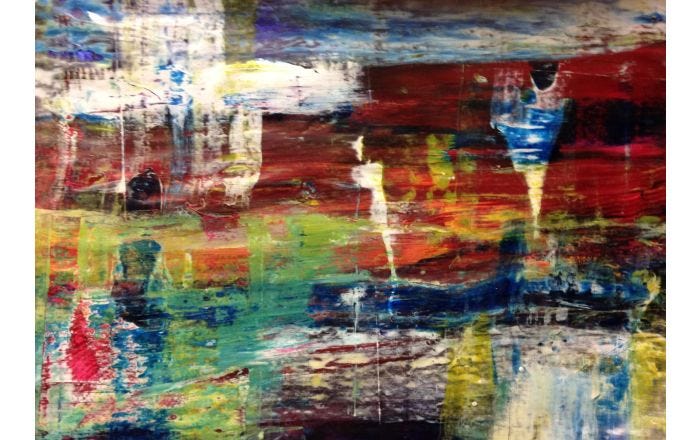
Encounter different approaches to making abstract paintings while developing your skills in using a range of painting materials. With reference to the work of a variety of abstract artists explore the visual language common to both representation and abstraction, eg. colour, composition, tone and paint application.
Learning modes and locations may be different depending on the course start date. Please check the location of your chosen course and read our guide to learning modes and locations to help you choose the right course for you.
Please note: We offer a wide variety of financial support to make courses affordable. Just visit our online Help Centre for more information on a range of topics including fees, online learning and FAQs.
Exploring different pathways into making abstract paintings.
Providing a stimulating atmosphere for personal discovery.
Encouraging an imaginative, sensitive and individual handling of acrylic paint with the edition of other water-based mixed media and collage.
Becoming familiar with visual language by looking at a variety of artists' work.
What will we cover?
Visual language in painting: colour, composition, tone and paint application.
Different methods of arriving at abstraction: eg. starting from observation, using experimental methods, randomness, conceptual systems and translating different sensory information.
What will I achieve? By the end of this course you should be able to...
Select the pictorial and material means with which to express a range of ideas, sensations and emotions.
Use with greater confidence the visual language common to both representation and abstraction.
Become increasingly confident with your use of colour.
What level is the course and do I need any particular skills?
This is a course for anyone with an open mind and/or some basic drawing or painting skills.
You should be able to follow simple written and verbal instructions, demonstrations, hand-outs and health and safety information, and will be invited to take part in group discussion.
How will I be taught, and will there be any work outside the class?
You will be guided through several processes to produce abstract paintings referring to specific artists or genres. As the course progresses you will develop an individual approach to making abstract paintings. Experimentation will be encouraged.
There will be practical projects, individual guidance and encouragement, group discussion and examination of artists' work.
Are there any other costs? Is there anything I need to bring?
Basic materials and resources are available as part of this course, including water-based paint, brushes and paper.
When I've finished, what course can I do next?
After completing this course you can progress directly onto Ways into abstract painting 2.
However, some students prefer to repeat Ways into abstract painting with a different tutor to gather more experience before progressing to the next level; your tutor will advise you. Alternative progression pathways might include: Ways into landscape painting, Draw-paint-print, Abstract painting weekend, Sketchbooks: creating visual journeys, Painting 1 or Painting 2.
Mario Lautier Vella is a cross-disciplinary, award-winning artist who began his art career at City Lit. After completing a number of short courses in drawing, painting, printmaking, sculpture and textiles, Mario went on to do the two-year City Lit Fine Art course before going back to university to gain his Masters degree. Mario regularly exhibits in the UK and abroad and his work can be found in private collections around the world. Mario has enjoyed teaching at City Lit since 2011. For more info go to mariolautiervella.com
Rebecca AllenSee moreSee less
After receiving a BFA degree from Kansas State University, Rebecca moved to New York and studied at the New York Studio School. There, she studied with a vast assortment of New York artists, many with ties to the abstract expressionist movement. The Studio School selected her as an exchangee student to study at the Slade School of Art in London for one year. Returning to New York, she received her MFA from Parsons School of Design. She has been teaching in London for over 20 years and created numerous courses, based on specific exhibitions and the permanent collection, at Dulwich Picture Gallery. Since 2010 she has been teaching at City Lit with courses including Life Drawing, Life Painting, Painting 2, Ways into Abstract Painting and many Watercolour courses. She has a background in figurative work, which has included observation, memory, and a love for tone and colour. More recent work is rooted in observation, yet more abstract in appearance, focusing on process and largely done using watercolour.
Amanda works with loose canvas, painting with line and stain before manipulating the picture into a low-relief form. Imagery is drawn from the natural world, architecture, costume and fairground. The work references visual taxonomies – orders of things: peculiar worlds, made more curious or multi-dimensional when removed from their context. Amanda studied at Falmouth School of Art, Institute of Arts Bournemouth, and Central St Martins (MA). She has a City & Guilds F&AE Teachers’ Certificate (1995) and has been teaching since, including outreach work for the Royal Watercolour Society, National Theatre, and Lewisham Education Action Zone. She has been teaching at City Lit since 2012, with a particular interest in Abstract Painting, Contemporary Painting, and Communication Drawing. She wrote, led and developed the City Lit Advanced Painting course from 2021–25, and presently coordinates the Drawing & Painting short-course programme. Amanda continues to teach Abstract Painting Weekend, Beginners Painting, and short modules in experimental Drawing.
Sisetta ZapponeSee moreSee less
Sisetta studied at the Florence Fine Arts Academy, earning a first-class degree as a Master Printmaker. In 2011, she moved to London, developing her printmaking practice while teaching workshops for adults of all abilities in various communities. She teaches Botanical Drawing, Watercolour, Advanced Life Drawing, and Printmaking, inspiring students to expand their skills and explore innovative approaches. She promotes art as a global language, celebrating diverse artistic traditions. Sisetta’s work is exhibited internationally and held in public collections, including Italy and Morocco’s National Collections, the V&A, and the Museum of Graphic Arts in Pisa.
Eleanor develops precarious and fragile forms through drawing, painting and sculpture. The abstracted forms of the sculptures are heavily influenced by drawings of architecture, organic forms and landscape. The work questions the interconnection between personal identity and place. Eleanor spent her formative years in Japan before moving to London. She completed the Drawing Year at the Royal Drawing School in 2008 and the Turps Art School’s Studio Programme in 2018. She has been teaching since 2008. Website: www.elbedlow.co.uk Instagram: @eleanorbedlow
Please note: We reserve the right to change our tutors from those advertised. This happens rarely, but if it does, we are unable to refund fees due to this. Our tutors may have different teaching styles; however we guarantee a consistent quality of teaching in all our courses.
product
https://www.citylit.ac.uk/ways-into-abstract-painting233790Ways into abstract paintinghttps://www.citylit.ac.uk/media/catalog/product/w/a/ways-into-abstract_painting-image1-vm053-vm357-vm712-vm790-1080.jpg389389GBPInStock/Courses/Courses/Art & design/Courses/Top rated courses/Courses/Art & design/Painting/Courses/Art & design/Painting/Painting techniques & processes/Courses/Last available places2285113216621916191917421228511321916Encounter different approaches to making abstract paintings while developing your skills in using a range of painting materials. With reference to the work of a variety of abstract artists explore the visual language common to both representation and abstraction, eg. colour, composition, tone and paint application.144.9https://www.citylit.ac.uk/media/catalog/product/w/a/ways_into_ab_p_-_nov_2016_1_20.jpg2540527Ways into abstract painting389389https://www.citylit.ac.uk/media/catalog/product/w/a/ways-into-abstract_painting-image1-vm053-vm357-vm712-vm790-1080_3.jpgInStockEveningFriKeeley StreetAvailable courses5-10 weeksWeekday2026-01-16T00:00:00+00:00BeginnersJan 2026Art & designVM790389389Ways into abstract painting311253389Mario Lautier Vellaways-into-abstract-painting/vm790-2526Encounter different approaches to making abstract paintings while developing your skills in using a range of painting materials. With reference to the work of a variety of abstract artists explore the visual language common to both representation and abstraction, eg. colour, composition, tone and paint application.0000-Available|2026-01-16 00:00:00<ul><li>Exploring different pathways into making abstract paintings.</li><li>Providing a stimulating atmosphere for personal discovery.</li><li>Encouraging an imaginative, sensitive and individual handling of acrylic paint with the edition of other water-based mixed media and collage.</li><li>Becoming familiar with visual language by looking at a variety of artists' work.</li></ul>Encounter different approaches to making abstract paintings while developing your skills in using a range of painting materials. With reference to the work of a variety of abstract artists explore the visual language common to both representation and abstraction, eg. colour, composition, tone and paint application.<ul><li>Visual language in painting: colour, composition, tone and paint application.</li><li>Different methods of arriving at abstraction: eg. starting from observation, using experimental methods, randomness, conceptual systems and translating different sensory information.</li></ul><ul><li>Select the pictorial and material means with which to express a range of ideas, sensations and emotions.</li><li>Use with greater confidence the visual language common to both representation and abstraction.</li><li>Become increasingly confident with your use of colour.</li></ul>This is a course for anyone with an open mind and/or some basic drawing or painting skills.<br/><br/>You should be able to follow simple written and verbal instructions, demonstrations, hand-outs and health and safety information, and will be invited to take part in group discussion.You will be guided through several processes to produce abstract paintings referring to specific artists or genres. As the course progresses you will develop an individual approach to making abstract paintings. Experimentation will be encouraged.<br/><br/>There will be practical projects, individual guidance and encouragement, group discussion and examination of artists' work.Basic materials and resources are available as part of this course, including water-based paint, brushes and paper.<p>After completing this course you can progress directly onto <em>Ways into abstract painting 2.</em></p><p>However, some students prefer to repeat <em>Ways into abstract painting</em> with a different tutor to gather more experience before progressing to the next level; your tutor will advise you.<em> </em> Alternative progression pathways might include: <em>Ways into landscape painting</em>, <em>Draw-paint-print</em>, <em>Abstract painting weekend</em>, <em>Sketchbooks: creating visual journeys</em>, <em>Painting 1</em> or <em>Painting 2.</em></p>PaintingPainting techniques & processesvirtual2540530Ways into abstract painting389389https://www.citylit.ac.uk/media/catalog/product/w/a/ways-into-abstract_painting-image1-vm053-vm357-vm712-vm790-1080_6.jpgInStockDaytimeMonKeeley StreetAvailable courses5-10 weeksWeekday2026-06-29T00:00:00+00:00Jun 2026Art & designVM946389389Ways into abstract painting311253389Eleanor Bedlowways-into-abstract-painting/vm946-2526Encounter different approaches to making abstract paintings while developing your skills in using a range of painting materials. With reference to the work of a variety of abstract artists explore the visual language common to both representation and abstraction, eg. colour, composition, tone and paint application.0000-Available|2026-06-29 00:00:00<ul><li>Exploring different pathways into making abstract paintings.</li><li>Providing a stimulating atmosphere for personal discovery.</li><li>Encouraging an imaginative, sensitive and individual handling of acrylic paint with the edition of other water-based mixed media and collage.</li><li>Becoming familiar with visual language by looking at a variety of artists' work.</li></ul>Encounter different approaches to making abstract paintings while developing your skills in using a range of painting materials. With reference to the work of a variety of abstract artists explore the visual language common to both representation and abstraction, eg. colour, composition, tone and paint application.<ul><li>Visual language in painting: colour, composition, tone and paint application.</li><li>Different methods of arriving at abstraction: eg. starting from observation, using experimental methods, randomness, conceptual systems and translating different sensory information.</li></ul><ul><li>Select the pictorial and material means with which to express a range of ideas, sensations and emotions.</li><li>Use with greater confidence the visual language common to both representation and abstraction.</li><li>Become increasingly confident with your use of colour.</li></ul>This is a course for anyone with an open mind and/or some basic drawing or painting skills.<br/><br/>You should be able to follow simple written and verbal instructions, demonstrations, hand-outs and health and safety information, and will be invited to take part in group discussion.You will be guided through several processes to produce abstract paintings referring to specific artists or genres. As the course progresses you will develop an individual approach to making abstract paintings. Experimentation will be encouraged.<br/><br/>There will be practical projects, individual guidance and encouragement, group discussion and examination of artists' work.Basic materials and resources are available as part of this course, including water-based paint, brushes and paper.<p>After completing this course you can progress directly onto <em>Ways into abstract painting 2.</em></p><p>However, some students prefer to repeat <em>Ways into abstract painting</em> with a different tutor to gather more experience before progressing to the next level; your tutor will advise you.<em> </em> Alternative progression pathways might include: <em>Ways into landscape painting</em>, <em>Draw-paint-print</em>, <em>Abstract painting weekend</em>, <em>Sketchbooks: creating visual journeys</em>, <em>Painting 1</em> or <em>Painting 2.</em></p>PaintingPainting techniques & processesvirtual2540521Ways into abstract painting389389https://www.citylit.ac.uk/media/catalog/product/w/a/ways-into-abstract_painting-image1-vm053-vm357-vm712-vm790-1080_5.jpgInStockDaytimeThuKeeley StreetAvailable courses5-10 weeksWeekday2026-04-23T00:00:00+00:00Apr 2026Art & designVM308389389Ways into abstract painting311253389Amanda Knight, Sisetta Zapponeways-into-abstract-painting/vm308-2526Encounter different approaches to making abstract paintings while developing your skills in using a range of painting materials. With reference to the work of a variety of abstract artists explore the visual language common to both representation and abstraction, eg. colour, composition, tone and paint application.0000-Available|2026-04-23 00:00:00<ul><li>Exploring different pathways into making abstract paintings.</li><li>Providing a stimulating atmosphere for personal discovery.</li><li>Encouraging an imaginative, sensitive and individual handling of acrylic paint with the edition of other water-based mixed media and collage.</li><li>Becoming familiar with visual language by looking at a variety of artists' work.</li></ul>Encounter different approaches to making abstract paintings while developing your skills in using a range of painting materials. With reference to the work of a variety of abstract artists explore the visual language common to both representation and abstraction, eg. colour, composition, tone and paint application.<ul><li>Visual language in painting: colour, composition, tone and paint application.</li><li>Different methods of arriving at abstraction: eg. starting from observation, using experimental methods, randomness, conceptual systems and translating different sensory information.</li></ul><ul><li>Select the pictorial and material means with which to express a range of ideas, sensations and emotions.</li><li>Use with greater confidence the visual language common to both representation and abstraction.</li><li>Become increasingly confident with your use of colour.</li></ul>This is a course for anyone with an open mind and/or some basic drawing or painting skills.<br/><br/>You should be able to follow simple written and verbal instructions, demonstrations, hand-outs and health and safety information, and will be invited to take part in group discussion.You will be guided through several processes to produce abstract paintings referring to specific artists or genres. As the course progresses you will develop an individual approach to making abstract paintings. Experimentation will be encouraged.<br/><br/>There will be practical projects, individual guidance and encouragement, group discussion and examination of artists' work.Basic materials and resources are available as part of this course, including water-based paint, brushes and paper.<p>After completing this course you can progress directly onto <em>Ways into abstract painting 2.</em></p><p>However, some students prefer to repeat <em>Ways into abstract painting</em> with a different tutor to gather more experience before progressing to the next level; your tutor will advise you.<em> </em> Alternative progression pathways might include: <em>Ways into landscape painting</em>, <em>Draw-paint-print</em>, <em>Abstract painting weekend</em>, <em>Sketchbooks: creating visual journeys</em>, <em>Painting 1</em> or <em>Painting 2.</em></p>PaintingPainting techniques & processesvirtual2540524Ways into abstract painting389389https://www.citylit.ac.uk/media/catalog/product/w/a/ways-into-abstract_painting-image1-vm053-vm357-vm712-vm790-1080_4.jpgInStockEveningTueKeeley StreetAvailable courses5-10 weeksWeekday2026-04-21T00:00:00+00:00BeginnersApr 2026Art & designVM674389389Ways into abstract painting311253389Rebecca Allenways-into-abstract-painting/vm674-2526Encounter different approaches to making abstract paintings while developing your skills in using a range of painting materials. With reference to the work of a variety of abstract artists explore the visual language common to both representation and abstraction, eg. colour, composition, tone and paint application.0000-Available|2026-04-21 00:00:00<ul><li>Exploring different pathways into making abstract paintings.</li><li>Providing a stimulating atmosphere for personal discovery.</li><li>Encouraging an imaginative, sensitive and individual handling of acrylic paint with the edition of other water-based mixed media and collage.</li><li>Becoming familiar with visual language by looking at a variety of artists' work.</li></ul>Encounter different approaches to making abstract paintings while developing your skills in using a range of painting materials. With reference to the work of a variety of abstract artists explore the visual language common to both representation and abstraction, eg. colour, composition, tone and paint application.<ul><li>Visual language in painting: colour, composition, tone and paint application.</li><li>Different methods of arriving at abstraction: eg. starting from observation, using experimental methods, randomness, conceptual systems and translating different sensory information.</li></ul><ul><li>Select the pictorial and material means with which to express a range of ideas, sensations and emotions.</li><li>Use with greater confidence the visual language common to both representation and abstraction.</li><li>Become increasingly confident with your use of colour.</li></ul>This is a course for anyone with an open mind and/or some basic drawing or painting skills.<br/><br/>You should be able to follow simple written and verbal instructions, demonstrations, hand-outs and health and safety information, and will be invited to take part in group discussion.You will be guided through several processes to produce abstract paintings referring to specific artists or genres. As the course progresses you will develop an individual approach to making abstract paintings. Experimentation will be encouraged.<br/><br/>There will be practical projects, individual guidance and encouragement, group discussion and examination of artists' work.Basic materials and resources are available as part of this course, including water-based paint, brushes and paper.<p>After completing this course you can progress directly onto <em>Ways into abstract painting 2.</em></p><p>However, some students prefer to repeat <em>Ways into abstract painting</em> with a different tutor to gather more experience before progressing to the next level; your tutor will advise you.<em> </em> Alternative progression pathways might include: <em>Ways into landscape painting</em>, <em>Draw-paint-print</em>, <em>Abstract painting weekend</em>, <em>Sketchbooks: creating visual journeys</em>, <em>Painting 1</em> or <em>Painting 2.</em></p>PaintingPainting techniques & processesvirtual311389253VM790,VM946,VM308,VM674NONEFri,Mon,Thu,Tue16/01/26 - 06/03/2618:00 - 21:0018:0021:008 sessions (over 8 weeks)85-10 weeksWeekdayKSKeeley StreetMario Lautier Vella,Eleanor Bedlow,Amanda Knight, Sisetta Zappone,Rebecca AllenAvailable courses2026-01-16T00:00:00+00:00,2026-06-29T00:00:00+00:00,2026-04-23T00:00:00+00:00,2026-04-21T00:00:00+00:00Evening,DaytimeJan 2026,Jun 2026,Apr 2026Art & design389389Ways into abstract paintingways-into-abstract-painting/vm790-2526,ways-into-abstract-painting/vm946-2526,ways-into-abstract-painting/vm308-2526,ways-into-abstract-painting/vm674-2526Encounter different approaches to making abstract paintings while developing your skills in using a range of painting materials. With reference to the work of a variety of abstract artists explore the visual language common to both representation and abstraction, eg. colour, composition, tone and paint application.0000-Available|2026-01-16 00:00:00<ul><li>Exploring different pathways into making abstract paintings.</li><li>Providing a stimulating atmosphere for personal discovery.</li><li>Encouraging an imaginative, sensitive and individual handling of acrylic paint with the edition of other water-based mixed media and collage.</li><li>Becoming familiar with visual language by looking at a variety of artists' work.</li></ul>Encounter different approaches to making abstract paintings while developing your skills in using a range of painting materials. With reference to the work of a variety of abstract artists explore the visual language common to both representation and abstraction, eg. colour, composition, tone and paint application.<ul><li>Visual language in painting: colour, composition, tone and paint application.</li><li>Different methods of arriving at abstraction: eg. starting from observation, using experimental methods, randomness, conceptual systems and translating different sensory information.</li></ul><ul><li>Select the pictorial and material means with which to express a range of ideas, sensations and emotions.</li><li>Use with greater confidence the visual language common to both representation and abstraction.</li><li>Become increasingly confident with your use of colour.</li></ul>This is a course for anyone with an open mind and/or some basic drawing or painting skills.<br/><br/>You should be able to follow simple written and verbal instructions, demonstrations, hand-outs and health and safety information, and will be invited to take part in group discussion.You will be guided through several processes to produce abstract paintings referring to specific artists or genres. As the course progresses you will develop an individual approach to making abstract paintings. Experimentation will be encouraged.<br/><br/>There will be practical projects, individual guidance and encouragement, group discussion and examination of artists' work.Basic materials and resources are available as part of this course, including water-based paint, brushes and paper.<p>After completing this course you can progress directly onto <em>Ways into abstract painting 2.</em></p><p>However, some students prefer to repeat <em>Ways into abstract painting</em> with a different tutor to gather more experience before progressing to the next level; your tutor will advise you.<em> </em> Alternative progression pathways might include: <em>Ways into landscape painting</em>, <em>Draw-paint-print</em>, <em>Abstract painting weekend</em>, <em>Sketchbooks: creating visual journeys</em>, <em>Painting 1</em> or <em>Painting 2.</em></p>PaintingPainting techniques & processesconfigurable